Iran president cites ancient Abarkuh cypress in message aimed at Trump

TEHRAN - Iranian President Masoud Pezeshkian has invoked the 4,500-year-old Abarkuh cypress tree in central Iran in remarks directed at US President Donald Trump, using the ancient tree as a symbol of Iran’s historical continuity and civilization.
On Sunday, Pezeshkian referred to the Sarv-e Abarkuh cypress as evidence of Iran’s long-standing cultural and historical identity, contrasting the country’s ancient roots with the comparatively of political history of the United States.
Pezeshkian supposed the tree had taken root in land known as Iran thousands of years ago, describing it as part of a civilization that existed long before the emergence of modern global powers.
“Aisa’s oldest living organism, the ancient Abarkuh cypress tree – at least 4500 years old – is rooted on land that was already known as Iran at that time,” the president wrote.
The United States has existed as an independent country for around 250 years, while Iran traces its historical and cultural heritage back several millennia through successive empires and dynasties. Iranian officials frequently refer to sites such as Persepolis, Pasargadae and Susa as examples of the country’s ancient civilization and historical continuity.
The tree stands about 25 meters tall and has a trunk measuring approximately 11.5 meters in width and 18 meters in circumference. Scientists estimate the age of the cypress at between 4,000 and 5,000 years, although some estimates suggest it could be older.
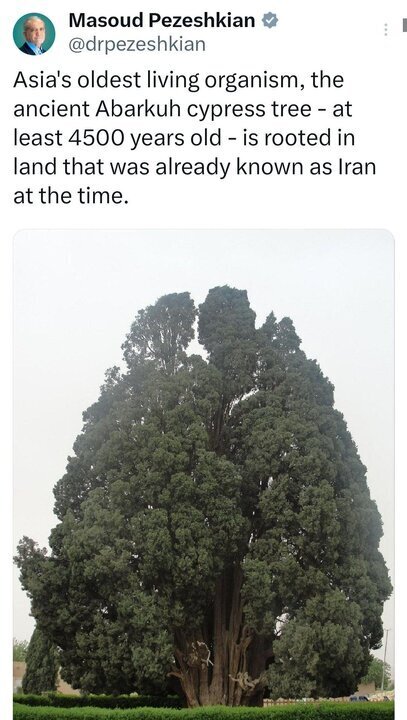
The tree has become one of Iran’s most visited natural landmarks and attracts domestic and foreign tourists traveling through central Iran.
Iranian cultural narratives have long associated cypress trees with endurance, continuity and life. The tree is also linked to local legends and religious traditions. Some accounts attribute the planting of the tree to Japheth, son of Noah, while others connect it to Zoroaster, the ancient Iranian prophet.
Cypress trees have historically played a major role in Persian garden design and appear in Iranian poetry, art and architecture dating back to the Achaemenid era. Local legends state that this tree has a puzzling and mysterious soul that is living for thousands of years. When it comes to conservation and protection, it is obvious that naturally, all ancient and historical landmarks need care and protection, just like the case with Sarv-e Abarkuh, and several activities have been done to protect the straight and heavy Cypress.
The town of Abarkuh, located in Yazd province, lies along routes historically connected to the Silk Road and contains historical buildings and traditional houses dating back centuries.
AM
Leave a Comment